Foundational hypothesis
Lattice Drive
Explore propulsion through the structure of space.
Investigate an inertia-less drive concept by testing direct momentum exchange with the proposed LSM lattice and, separately, changes in inertial response.
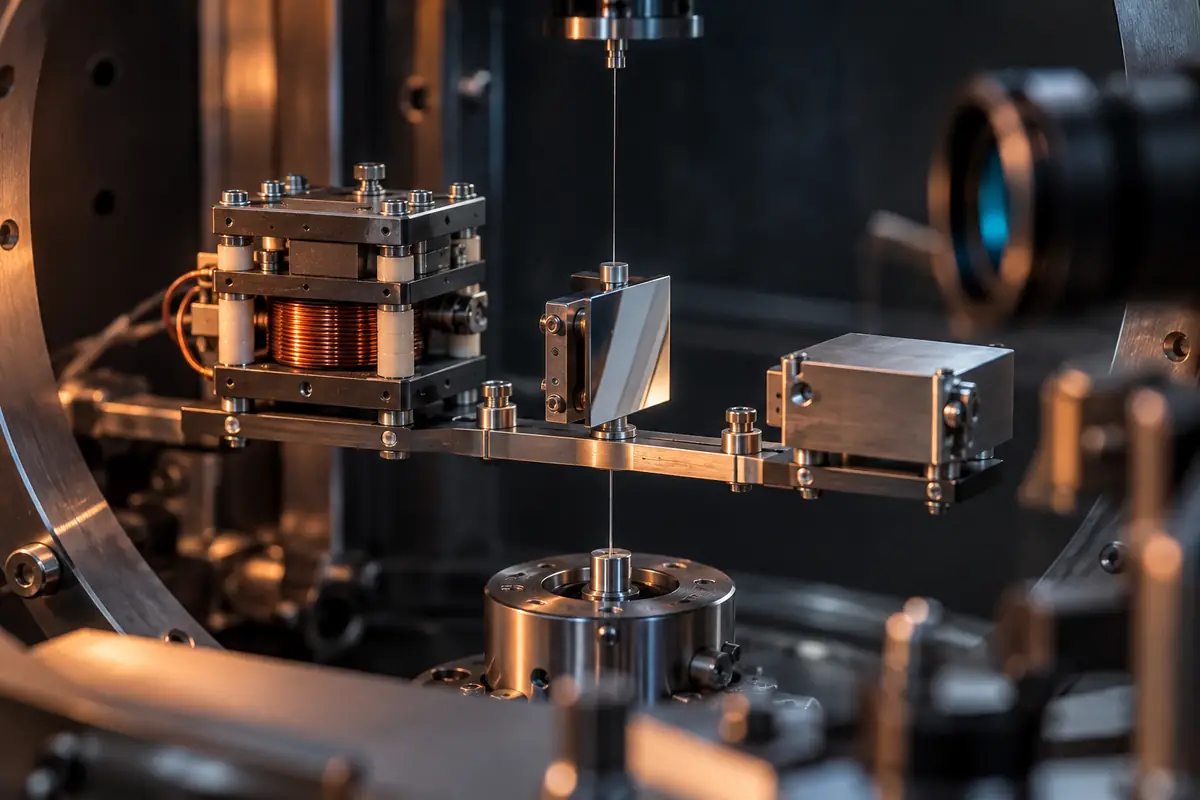

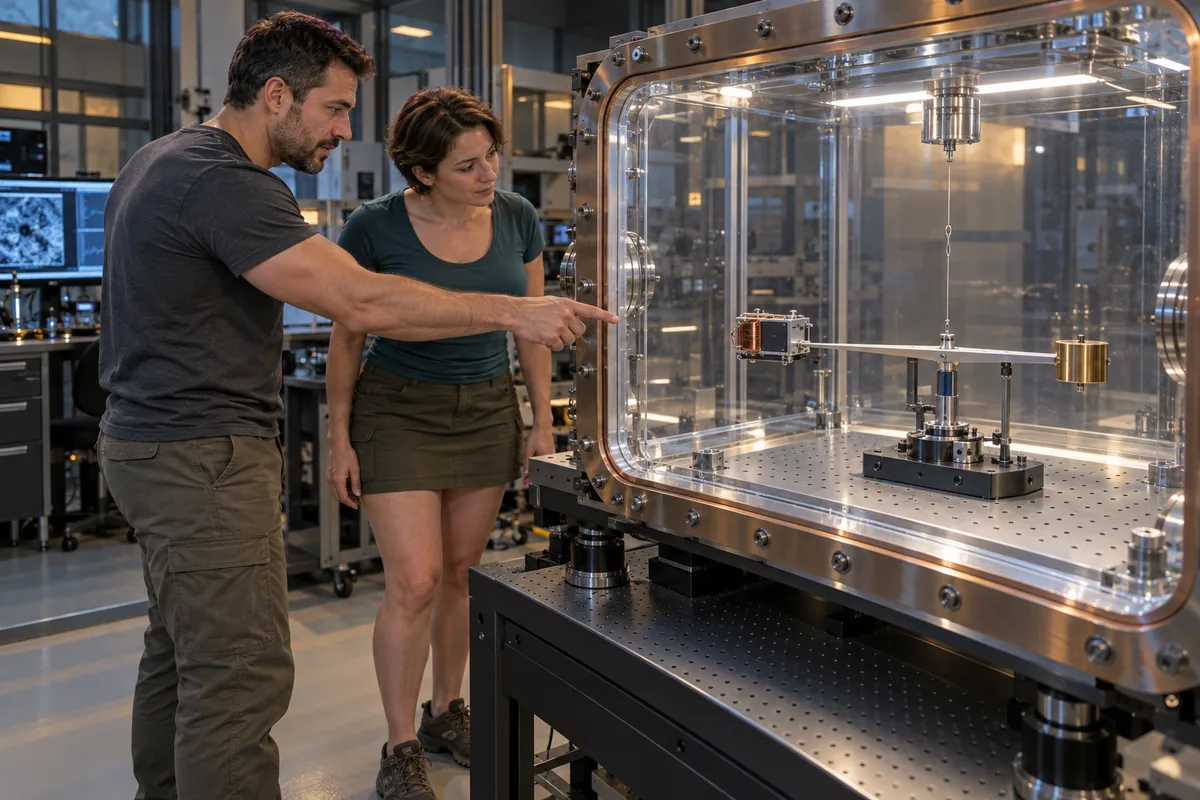
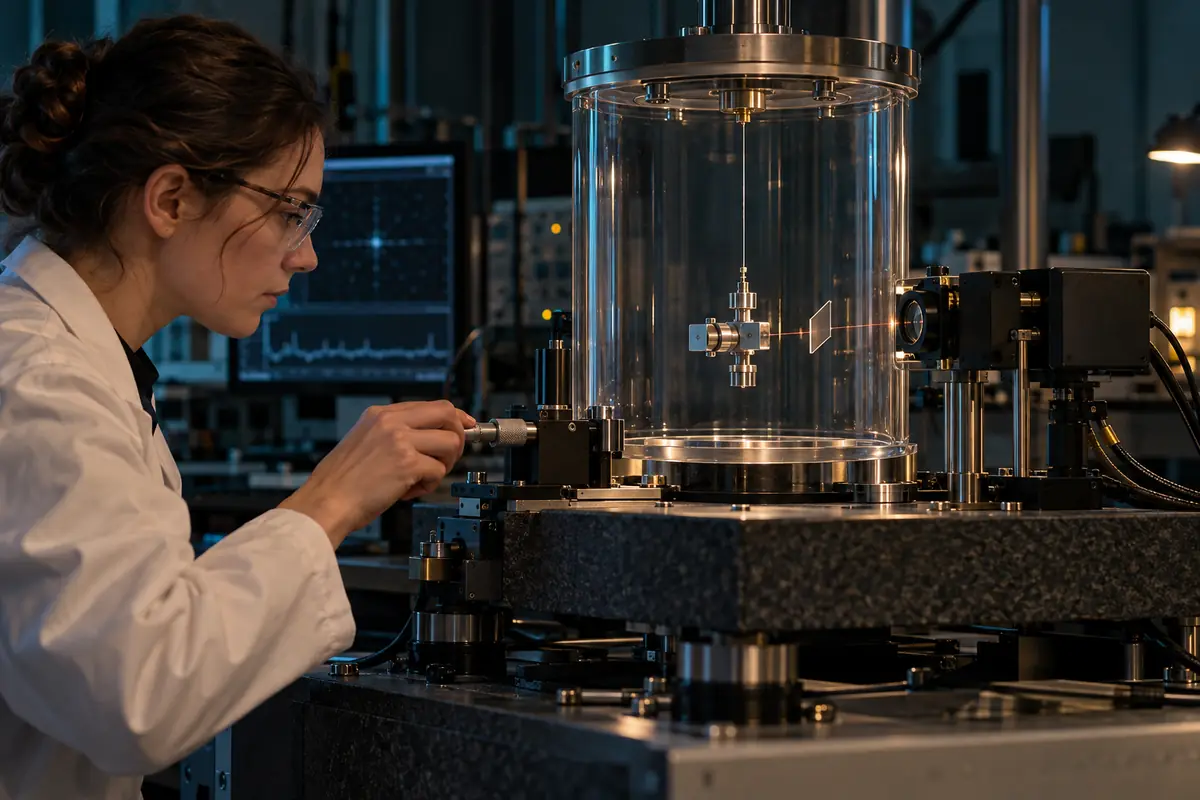
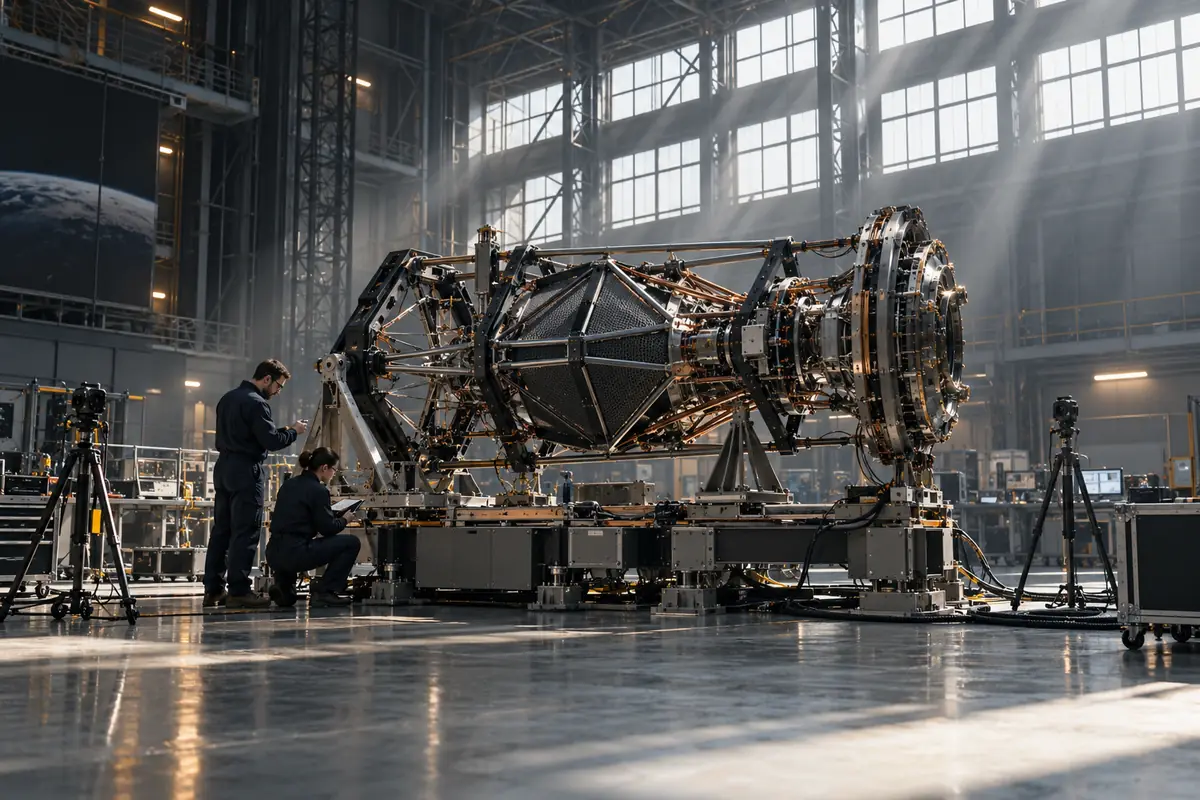
AI-generated concept imagery · imagined settings and equipment
Next review · October 2, 2026
A creation–stroke–recovery model with an explicit momentum carrier
Awaiting coupling law · Lead: Ben Đ Om
Acceptance: Derive the coupling and predict reversal behavior; close the whole-device energy and momentum accounts.
Resources: Analytical work only. This is a planning allowance, not a funded commitment.
Download the experiment work pack · View the next work cycle
The vision
What this could become.
Explore whether a vehicle could move by coupling directly to the lattice proposed by LSM, transferring momentum into its surroundings instead of expelling carried propellant. A parallel research track asks whether that coupling could alter the vehicle’s inertial response. The long-term ambition is a new form of controlled motion, beginning with a precise prediction and a very small, reproducible measurement.
Begin today
The first concrete step.
Define a channel for creating localized massive states from supplied energy along the proposed flagellum. Derive their lattice interaction, the force transmitted to the device, and a full creation–stroke–recovery cycle. Predict how reversing the synthesis sequence changes motion, and close the energy and momentum accounts before selecting an experimental apparatus.
The LSM connection
Ben proposes direct energy-to-matter synthesis in situ as the flagellum’s coupling mechanism. LSM must describe how the created state differs from its source energy in localization and substrate interaction, and how that interaction transfers momentum to the complete device. The geometric construction alone has not yet supplied an experimentally validated synthesis-driven coupling law.
Current evidence & open ground
Neither an inertia-less drive nor propulsion by direct coupling to an LSM lattice has been demonstrated. If the lattice receives opposite momentum, the proposal is an external momentum-exchange mechanism, not a reactionless closed system. Producing thrust, changing inertial mass, and reducing acceleration loads on occupants are different claims that require different measurements.
NASA / Millis — The Challenge to Create the Space Drive ↗A historical research framework for identifying coupling mechanisms and closing momentum budgets; not validation of LSM propulsion.
Tajmar, Neunzig & Weikert — precision thrust measurements ↗Experimental lessons on thermal and electromagnetic false positives. The tested EMDrive showed no anomalous thrust within the reported sensitivity.
Chattopadhyay et al. — Swimming Efficiency of Bacterium Escherichia Coli ↗Primary measurements of the propulsion matrix relating flagellar rotation to force and torque in a fluid; no claim about an LSM substrate.
Qiu et al. — Swimming by reciprocal motion at low Reynolds number ↗The Newtonian low-Reynolds-number symmetry restriction and experimental exceptions in non-Newtonian fluids; useful limits on transferring the analogy.
Questions that move the work forward
- Which controllable physical field couples to which lattice variable, and what equation fixes the strength and direction of the interaction?
- What carries the compensating momentum away, and can its energy, propagation, and boundary interactions be tracked?
- Does the model predict a reproducible response under reversal, orientation changes, and changes in drive timing?
- Can any claimed inertial change be separated from additional forces, altered stiffness, damping, and measurement feedback?
Swim through structure
The proposed flagellum creates mass in situ from supplied energy, forming a traveling sequence of localized massive states. Investigate whether their creation, lattice interaction, and recovery can produce a directed stroke. The following extension separates the proposed mass-synthesis mechanism, established swimming mechanics, exact drive geometry, and the complete interaction still to be derived.
Research extension · 24 September 2026
A flagellum synthesized from energy
Ben’s proposed coupling mechanism is direct energy-to-matter synthesis in situ along the flagellum. The field flagellum would create localized massive excitations in an ordered sequence. Their formation, interaction with the proposed LSM substrate, and subsequent removal or recovery would form a traveling stroke. Mass production is the specified candidate mechanism; whether it provides a controllable lattice interaction remains to be derived.
Create, couple, advance, recover
- Create. Concentrate supplied energy at one location to form a specified massive state. Account for every created particle, its charge, momentum, rest energy, and kinetic energy.
- Couple. Calculate how that newly localized state interacts with the lattice and how a force is transmitted back to the device. Creation alone does not establish an anchor or a propulsive impulse.
- Advance. Phase neighboring synthesis sites so the distribution of massive states and the accompanying deformation progress along the flagellum. Coordinate synthesis with a second control, such as displacement or state orientation, to define a complete stroke.
- Recover or release. Specify the fate of the created matter: retain it, emit it, or convert it back into recoverable radiation through an allowed process. Include the momentum and energy of this step before evaluating the cycle.
One possible control hypothesis is stronger coupling during the working stroke and weaker coupling during recovery. That contrast must follow from the synthesized state’s geometry and dynamics. The energy-bearing fields before synthesis already possess energy and momentum; converting them into particle rest mass does not switch inertia or gravitational influence on from zero. The proposed advantage would have to arise from a change in localization, state, or interaction.
A traveling production pattern / prescribed input
Sₙ(t) = S₀ f(ωt − knℓ), f ≥ 0
Sₙ is the rest-mass production rate at site n, ℓ the site spacing, and f a nonnegative periodic pulse shape. Phase reversal reverses the sequence of creation events. This sequence is not itself a prediction of device motion.
∂ρm/∂t + ∇·jm
= Screate − Sremove
ρm tracks the created population’s rest-mass density and jm its transport. The removal term needs a physical process and corresponding energy products. Track total energy and momentum separately across the matter, fields, substrate, and complete apparatus, without counting the created matter twice.
The energy ledger belongs inside the stroke
Creating a total particle rest mass Δm requires at least Δm c² of energy, with additional requirements for kinetic energy and losses. For scale, 1 picogram corresponds to about 89.9 joules of rest energy. A repeating design must specify both the amount created per cycle and how much energy is recovered; circulating energy and net power consumption are different quantities. Retained matter accumulates, emitted matter is an exhaust stream, and conversion back to radiation requires accounting for its recoil and collection.
Electron–positron production from energetic photon interactions provides an established example of energy-to-matter conversion; it does not establish the proposed lattice coupling or an efficient synthesis array. The pair has zero net charge and a minimum combined rest energy of approximately 1.022 MeV. A candidate must meet the total incoming energy–momentum condition, not just a chosen photon frequency. See Burke et al., 1997 and STAR Collaboration, 2021. Any different LSM synthesis channel needs its own conservation and transition rules.
The decisive extension: derive the difference between the substrate response to the incoming energy and to the synthesized state, then follow creation, the working stroke, and recovery together. A surviving device impulse must be balanced by substrate or outgoing momentum. If all states return internally with no external momentum transfer, redistributing mass-energy does not propel the closed apparatus. Choose the created state by its derived interaction per energy cost, not by rest mass alone.
What the biological mechanism contributes
Bacterial flagella commonly rotate as helices; eukaryotic flagella propagate bending waves. In a viscous fluid, a slender filament experiences different resistance to motion across its length and along it. Combined with an ordered rotation or wave, that directional resistance produces propulsion. The surrounding fluid receives the corresponding forces and torque; the swimmer is not an isolated momentum source.
At very low Reynolds number, ordinary inertia becomes small compared with viscous forces. For an incompressible Newtonian fluid in this regime, a stroke that exactly retraces its sequence of shapes gives no net travel. A rotating helix or a traveling bend avoids that cancellation. This is a useful symmetry guide, not a theorem automatically applicable to an unknown LSM medium: elasticity, memory, wave propagation, and nonlinear response must be derived for that medium.
| Flagellar ingredient | Project E counterpart |
|---|---|
| Fluid with a defined response | A dynamical LSM substrate with a specified energy, response law, and physical momentum density. |
| Rotating helix or traveling bend | Two coordinated deformation modes or a phased array that moves a perturbation along the device. |
| Directional drag and geometry | A derived orientation-dependent interaction, or another mechanism that turns the drive cycle into directional momentum transfer. |
| Flow, stress, and counter-rotation | Accounted substrate and field motion, outgoing excitations, and compensating angular momentum. |
Two modes make a traveling stroke
Begin with two independently controlled mode amplitudes. For the synthesis proposal, these describe modulation of production and configuration; a signed mode amplitude is not negative physical mass. The resulting production rate and mass density must remain nonnegative. Let the modes’ phase offset be φ:
q₁ = a cos(ωt)
q₂ = b cos(ωt − φ)
Here a and b are commanded amplitudes, ω is the drive frequency, and φ is the timing offset. These are experimental settings, not fitted fundamental constants.
At φ = +π/2, the pair traces a loop in its two-mode state space. At −π/2 it traces the same loop backwards. At zero phase offset, it retraces a line. For equal amplitudes and spatial modes cos(ks) and sin(ks), the +π/2 cycle gives the exact identity:
q₁ cos(ks) + q₂ sin(ks)
= a cos(ks − ωt)
s measures position along the array and k = 2π/λ sets the imposed wavelength. Reverse the phase offset to reverse the wave. This describes the commanded pattern; the substrate response is still to be calculated.
The modes return to their starting state around a loop. Reversing the order reverses its orientation.
The same states are retraced. This is the reciprocal comparison cycle.
The normalized diagrams show drive geometry only. Neither the loop nor its area establishes thrust. An oriented cycle provides a direction to test; a physical coupling must convert it into movement.
Where a displacement law could come from
If a derived response permits the medium to be eliminated into an instantaneous, force-balanced mobility law, translation along a fixed axis can take the form below. This is a conditional reduced model, not an established LSM equation:
U = A₁(q)q̇₁ + A₂(q)q̇₂
ΔX = ∮ (A₁ dq₁ + A₂ dq₂)
For a small loop, approximately constant mobility curvature gives
ΔX ≈ πab sinφ (∂A₂/∂q₁ − ∂A₁/∂q₂).
The A coefficients must follow from the interaction and medium response. If their relevant curvature vanishes, this stroke produces no translation in this reduced model. With appreciable inertia, memory, or radiating modes, integrate the full coupled dynamics instead.
A starting interaction can be written schematically as Hint = ∫ J(x − X, q) O(x) d³x, with device force FX = −∂Hint/∂X. For this proposal, J must be derived from the synthesized matter state together with its generating fields, and O is the substrate quantity to which it couples. An additional creation/removal interaction must account for conversion between the fields and matter. LSM must supply the physical operators, units, interaction strengths, dynamics, and reciprocal forces. A zero-parameter fundamental model must derive those strengths rather than select them to produce the desired thrust.
In a discrete-lattice calculation, distinguish true total mechanical momentum from a mode’s crystal momentum or pseudomomentum. A moving defect or a traveling occupancy pattern alone does not demonstrate transport of the complete device.
Three directions for the first model
- Rotating helical coupling. Test whether a chiral interaction geometry converts rotation into translation. Reversing the rotation or mirroring the geometry should reverse the translation in a parity-symmetric medium; calculate any lattice-orientation dependence.
- Traveling deformation. Drive neighboring elements with progressively shifted phase. Compare forward and reverse traveling patterns with a standing pattern at matched measured power and temperature.
- Coordinated arrays. After establishing one element, investigate phase-delayed rows analogous to coordinated cilia. Determine collective response before assuming forces add; waves may interfere or cancel. Counter-rotating mirrored pairs could cancel torque while adding thrust only if the derived coupling supports it.
The first discriminating calculation
Simulate a freely moving device, its power source, fields, and a finite dynamical substrate. Start with zero total momentum. Compare phase offsets +π/2, −π/2, 0, and π; then disable the candidate interaction and repeat. Record device displacement and velocity, the full-cycle impulse, medium momentum, outgoing flux, input energy, and stored and dissipated energy. Include the final relaxation so a temporary shift of internal parts is not counted as sustained transport.
For the proposed small-loop mechanism, seek an odd response under φ → −φ and a vanishing leading geometric term for φ = 0 or π. Those are model-specific signatures, not universal predictions for every possible medium. A steady freely swimming system can translate with zero mean total force after transients; measure displacement per cycle as well as the holding force in a separate constrained experiment.
The next result to earn: derive one controllable coupling for which reversing the stroke reverses relative device motion, with the complete energy and momentum accounting closed. Then choose the field generator, frequency, geometry, and measurement sensitivity. LSM has not yet established the required coupling, so no thrust, operating frequency, or vehicle performance is assigned here.
Flagellar motion supplies a route to propulsion through a medium. Its low-inertia fluid regime does not mean the organism has lost inertial mass. Project E’s separate tests for inertial response and occupant acceleration remain necessary.
Two distinct experimental tracks
| Track | Question | Measurement |
|---|---|---|
| Lattice-coupled thrust | Does the driven device exchange momentum with a defined lattice excitation? | Net impulse over a complete operating cycle, input energy, and the predicted compensating momentum. |
| Inertial response | Does the response to an independently calibrated external force change when the coupling is active? | Acceleration and phase response across loads and frequencies, after accounting for all other forces, stiffness, and damping. |
Momentum accounting / proposed enlarged system
d(pdevice + pfield + plattice)/dt = Fexternal
The model must define every term rather than treating “the lattice” as an unmeasured momentum reservoir. Audit angular momentum and the energy budget as well. A force on the vehicle would not, by itself, show reduced inertia or reduced acceleration loads on people inside it.
Start with an instrument that can return a useful null result
Choose a torsion balance or suitable isolated force platform after deriving the expected signal. Calibrate before and after trials; use randomized drive states, reversed orientations, and a dummy load with comparable electrical and thermal behavior. Track temperature drift, cable forces, vibration, outgassing, electrostatic and magnetic interactions, and emitted radiation. Repeat any surviving signal on an independent apparatus.
Keep the claimed force separate from displacement caused by heating or support deformation. In simulations, track the reaction at clamped boundaries and momentum crossing the modeled region; a fixed lattice boundary can act as an external support and imitate a successful drive.
A conventional reference point
A perfectly directed photon exhaust produces F = Pemitted/c, approximately 3.34 μN for 1 kW of outgoing light. This is a radiation-recoil benchmark, not a universal limit on systems exchanging momentum with an external medium. Exceeding that reference would not alone identify a lattice interaction.
Report impulse per input energy, the complete-cycle force history, uncertainty, and detection limits before extrapolating to a vehicle. Connect any future power and waste-heat estimates to Dewcell and Earth Radiator; useful thrust and heat rejection must scale together.
Proposed milestones / not completed results
A path to evidence.
Derive the coupling
A versioned dynamical model with explicit drive variables, a momentum carrier, and quantitative predictions.
Advance when: Close the energy and momentum budgets and specify a result that would reject the candidate coupling.
Audit the simulation
A coupled device–field–lattice simulation with complete impulse and energy records.
Advance when: Show that any predicted motion survives resolution changes and is not thrust against an unnoticed fixed simulation boundary.
Measure a small effect
A calibrated thrust or force-response experiment with matched controls, drive reversal, and environmental monitoring.
Advance when: Separate the proposed response from thermal, electromagnetic, mechanical, gas, and radiation effects; report a detection limit when no effect appears.
Replicate before scaling
Independent apparatus and analysis for any surviving signal, followed by separate inertial-response tests.
Advance when: Reproduce the predicted scaling and distinguish lattice coupling from unexplained thrust before assigning propulsion performance.
Visitor feedback
Comments or suggestions?
Share your thoughts on Lattice Drive. Your message goes to the site owner’s private inbox.
No sign-in required. Your message and optional contact details are saved privately for review, not published. Add an email address if you would like a reply; a response is not guaranteed. Please avoid sensitive information.