Meta-project · feasibility study
Earth Radiator
Abundant power. A livable planet.
A shared planetary heat budget and a research program for moving fusion waste heat through Skyway corridors to night-side outlets and deep space.

AI-generated concept imagery · imagined settings and equipment
Next review · October 2, 2026
A complete metering diagram for one small thermal loop
Queued · Lead: Ben Đ Om
Acceptance: Account for heater input, pumping, storage and rejection without double counting.
Resources: Design only; components not allocated. This is a planning allowance, not a funded commitment.
Download the experiment work pack · View the next work cycle
The vision
What this could become.
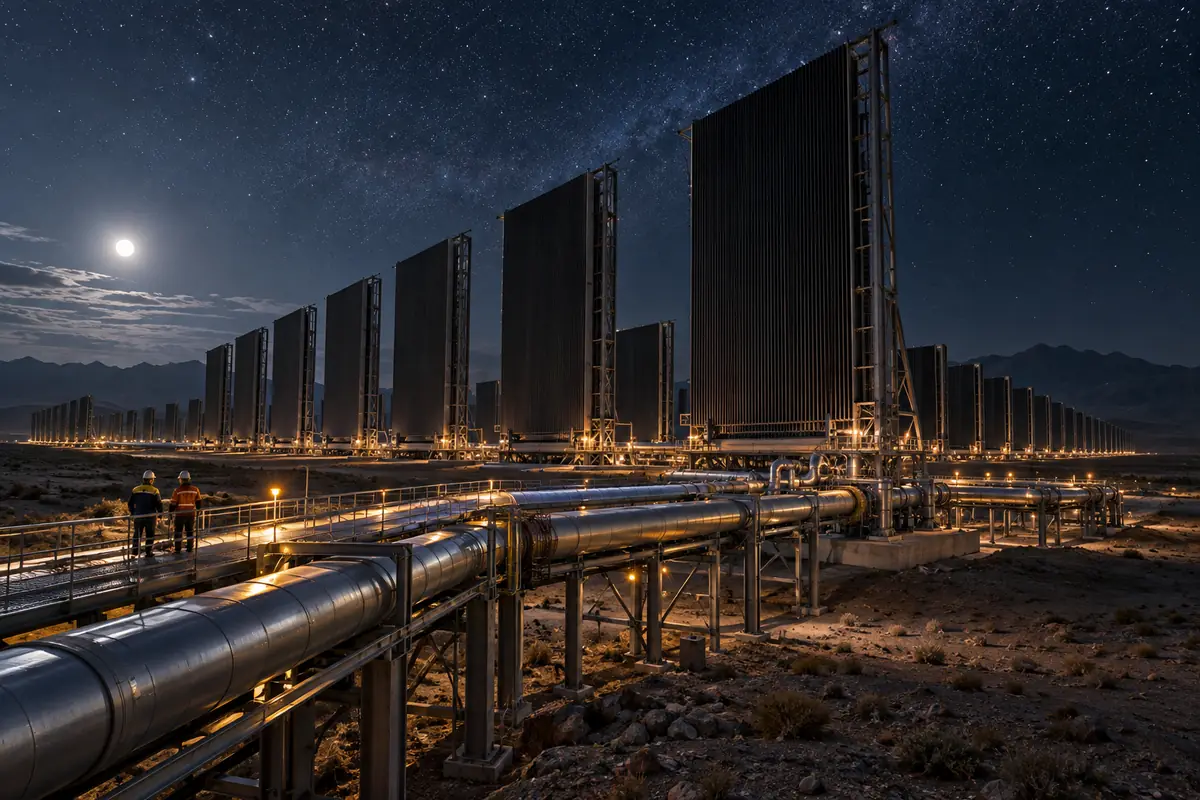
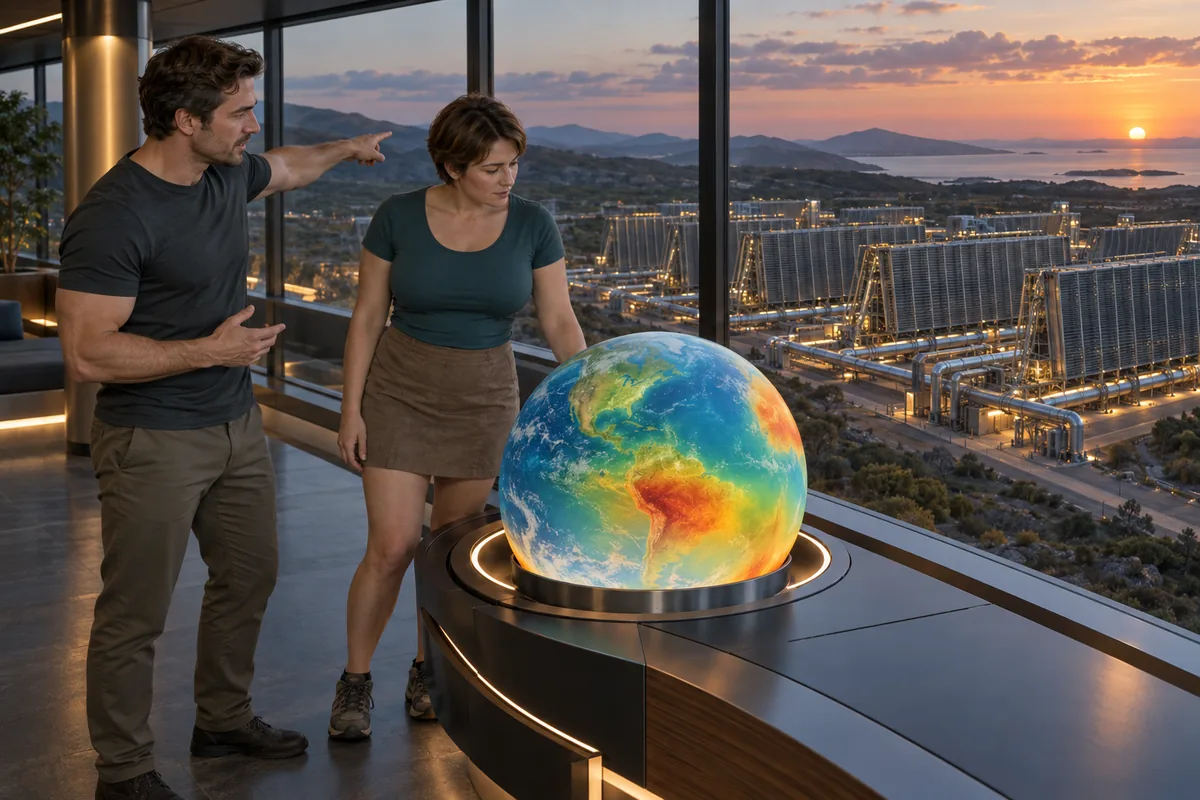
Build heat removal into the expansion of energy abundance. Earth Radiator connects every project to a common energy ledger, a measured heat-rejection capacity, and a plan for staying within that capacity. The flagship concept uses Skyway’s infrastructure corridors to collect and transport waste heat toward outlets on Earth’s night side, then radiate or otherwise export that energy into deep space.
Begin today
The first concrete step.
Create a scenario-based planetary heat ledger and an instrumented thermal-loop demonstrator. Compare a local sky-facing radiator with a longer loop representing a Skyway corridor; measure heat removed from the load, heat lost along the route, pumping power, thermal storage, and the receiving radiator’s net performance.
The LSM connection
This is the enabling meta-project for a future in which LSM-based fusion becomes viable and widely deployed. The thermal accounting applies regardless of the eventual fusion mechanism. It adds a heat-budget requirement to Dewcell, Haven, Skyway, Lightloom, and the rest of the program, while Meridian provides a possible future route to orbital infrastructure.
Current evidence & open ground
Fusion energy released and used on Earth largely becomes heat, including useful electricity after it is consumed. The warming burden depends on deployment scale, displaced energy sources, and additional energy escaping to space; a massive temperature rise is not inevitable merely because fusion becomes available. Transporting heat to another place redistributes it. Planetary cooling requires a net increase in energy leaving the Earth system, with auxiliary power and losses included.
NASA — Earth’s radiation budget ↗The top-of-atmosphere accounting boundary for incoming and outgoing energy.
NASA CERES — energy-budget observations ↗A monitoring baseline for reflected solar and outgoing thermal radiation.
NASA — spacecraft thermal control ↗Radiators, heat transport, and environmental heat loads in space.
Raman et al., Nature (2014) — radiative cooling ↗Demonstrated terrestrial cooling through the atmospheric infrared window; not a planetary heat-export network.
Questions that move the work forward
- At what deployment scale does additional Earth-deposited power exceed the program’s chosen heat budget, and how would that limit be independently reviewed?
- Can shared Skyway corridors deliver more heat to effective radiators than they add through pumping, leakage, and other operations?
- Which combination of terrestrial emission, orbital radiators, and directed energy export gives the most net removal per unit of infrastructure?
- How should the system respond when clouds, equipment faults, or capacity shortages reduce heat export?
The night side becomes a distributed destination
The anti-solar point is the antipode of the subsolar point: the place where the Sun is directly below the horizon through Earth’s center. It moves across the surface as Earth rotates, so one fixed terminal cannot remain there. Study a network of outlets that hands off service as night moves, with storage and routing chosen by actual sky conditions. Deep-space visibility, atmospheric transmission, and transport cost matter more than hitting one exact point.
Skyway as a thermal utility corridor
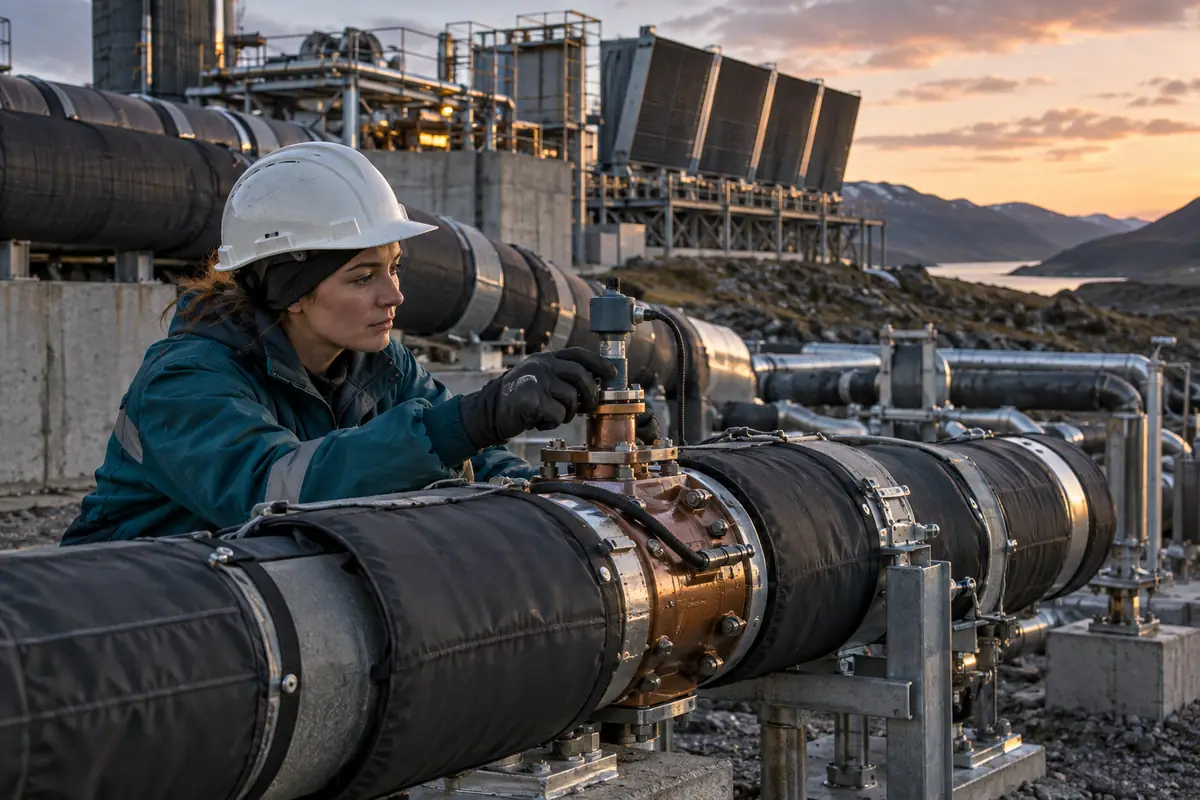
Investigate insulated heat-transfer lines along the guideway, with separate thermal services at energy plants and large users. Recover useful heat locally first, then route the remaining load to nearby effective outlets or storage. A regional pilot must establish fluid choice, pressure, thermal expansion, insulation, and pumping losses before any planetary network is credible.
| Path | Proposed role | Decisive question |
|---|---|---|
| Night-side ground stations | Skyway corridors feed distributed, sky-facing emitters; service shifts as night and weather move. | How much additional radiation actually escapes through the atmosphere, after transport and auxiliaries? |
| Orbital radiators | Explore Meridian-supported infrastructure or move heat-intensive activities into space. | How does terrestrial heat reach the radiator? Space access alone does not transport a continuous heat load. |
| Directed emission | Evaluate outward-directed radiation or a separate active beam-conversion concept. | Can the complete system remove Earth’s heat after conversion losses and power demands? |
Night reduces direct solar heating; it does not remove atmospheric absorption. Ground emitters must account for clouds, water vapour, sky radiation, and spectral transmission. An orbital radiator must account for sunlight, Earth infrared, reflected light, and its view of deep space.
Radiation is the exit. Beaming is a separate question.
Thermal radiation already carries energy into space. Concentrating low-temperature, disordered waste heat into a narrow beam is not a lossless optical rearrangement. A powered converter needs a full thermodynamic and optical model. Its success measure is extra energy removed from Earth’s heat inventory, after counting the energy supplied to operate it.
How large is the heat burden?
For additional power that thermalizes on Earth, divide by the full surface area, approximately 510 million km². These are direct heat inputs before compensating export or climate response, not temperature predictions.
| Additional thermalized power | Global mean heat input |
|---|---|
| 1 TW | 0.00196 W/m² |
| 100 TW | 0.196 W/m² |
| 1,000 TW | 1.961 W/m² |
Ideal radiator scale / vacuum bound
Q = εσA(T⁴ − Tspace⁴)
At ε = 0.9 and a 3 K background, emitting 1 TW needs approximately 2,419 km² at 300 K, or 151 km² at 600 K. This is total emitting area with an unobstructed cold-space view, no incoming environmental heat, and no atmosphere. It is not a ground-station area estimate.
A hotter radiator needs a hotter source or a heat pump. Ideally lifting heat from 300 K to 600 K needs at least 1 watt of work per watt removed from the cold load; the hot side must then reject at least 2 watts. Real equipment requires more work.
Transport scale: carrying 1 TW with a water-like fluid at cp = 4.18 kJ/(kg·K) and a 50 K temperature change requires about 4.78 million kg/s of flow, before losses. This sets a serious sizing question for Skyway corridors and motivates comparisons with local radiators and moving suitable activity off Earth.
One ledger across the portfolio
Record each project’s power source, energy imports, heat temperatures, geography, operating schedule, storage, and measured rejection path. Count reactor conversion losses and eventual end-use dissipation once each; count pumping and conversion inputs once at their energy source. Reusing heat changes when and where it is released, but does not by itself remove it from Earth.
Use the difference between a deployment scenario and its stated baseline, including displaced generation. Track both the global top-of-atmosphere balance and local thermal limits, informed by satellite radiation observations and regional measurements. Storage buffers an outage; curtailment handles sustained loss of rejection capacity. No cooling credit is granted just for moving heat to another region.
Proposed milestones / not completed results
A path to evidence.
Account for every watt
A common ledger with 1, 100, and 1,000 TW scenarios; energy demand, source temperatures, uncertainty, and regional heat maps.
Advance when: Reconcile generation, end-use dissipation, storage, and export without double counting. Set proposed operating limits as policy choices, not physical constants.
Close one thermal loop
A proposed 1–10 kW electrical-heater test, a corridor-length study, thermal storage, and a characterized radiator.
Advance when: Demonstrate useful heat removal after auxiliaries; distinguish heat delivered to the local sky from energy that actually reaches space.
Prove the export path
Compare distributed night-side outlets, a representative vacuum radiator, and a separately evaluated directed-emission concept.
Advance when: Measure the complete energy balance and realistic atmospheric or orbital geometry; do not extrapolate ideal radiator area into a validated installation.
Coordinate deployment
A shared capacity model with reservations, local limits, outage behavior, and a transparent audit trail for every energy-intensive project.
Advance when: Expand heat-producing operations only as independently verified rejection capacity and environmental limits permit.
Visitor feedback
Comments or suggestions?
Share your thoughts on Earth Radiator. Your message goes to the site owner’s private inbox.
No sign-in required. Your message and optional contact details are saved privately for review, not published. Add an email address if you would like a reply; a response is not guaranteed. Please avoid sensitive information.