Feasibility study
Lightloom
Write structure with light, atom by atom.
Dual-axis mirror arrays and coordinated optical tweezers for parallel atom handling and eventual device assembly.
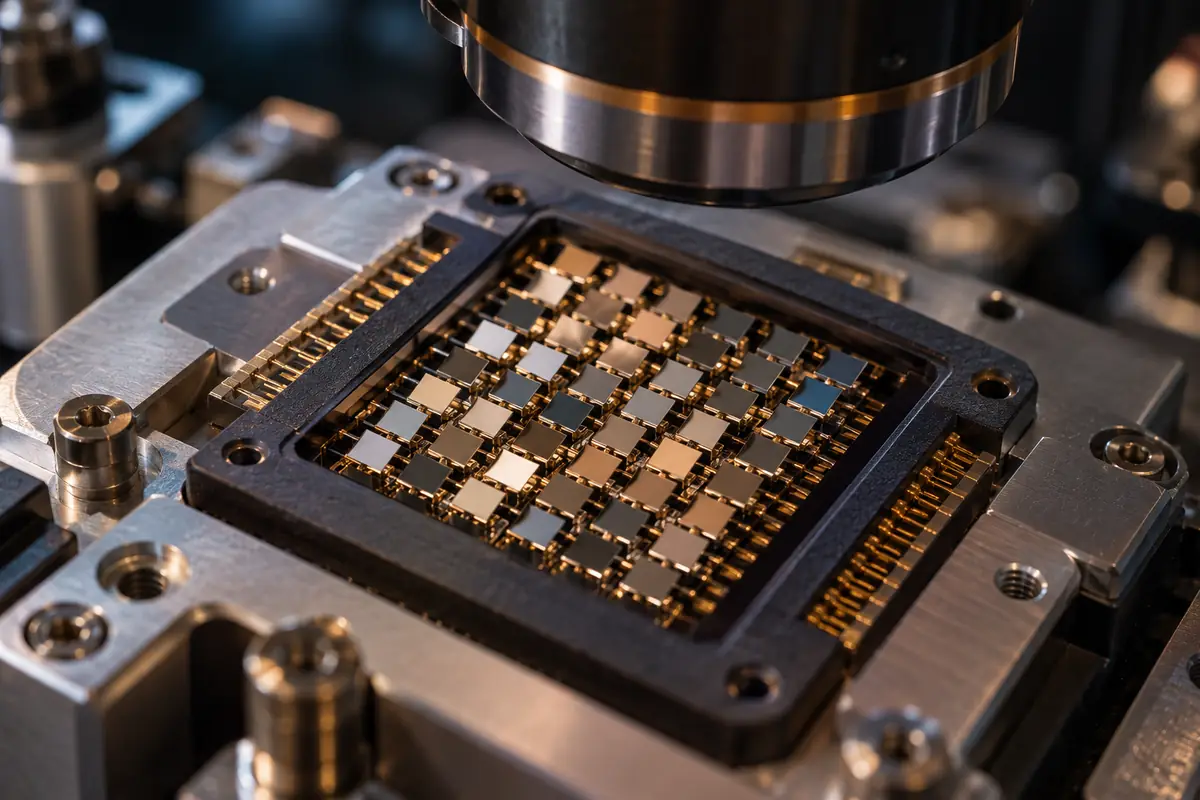

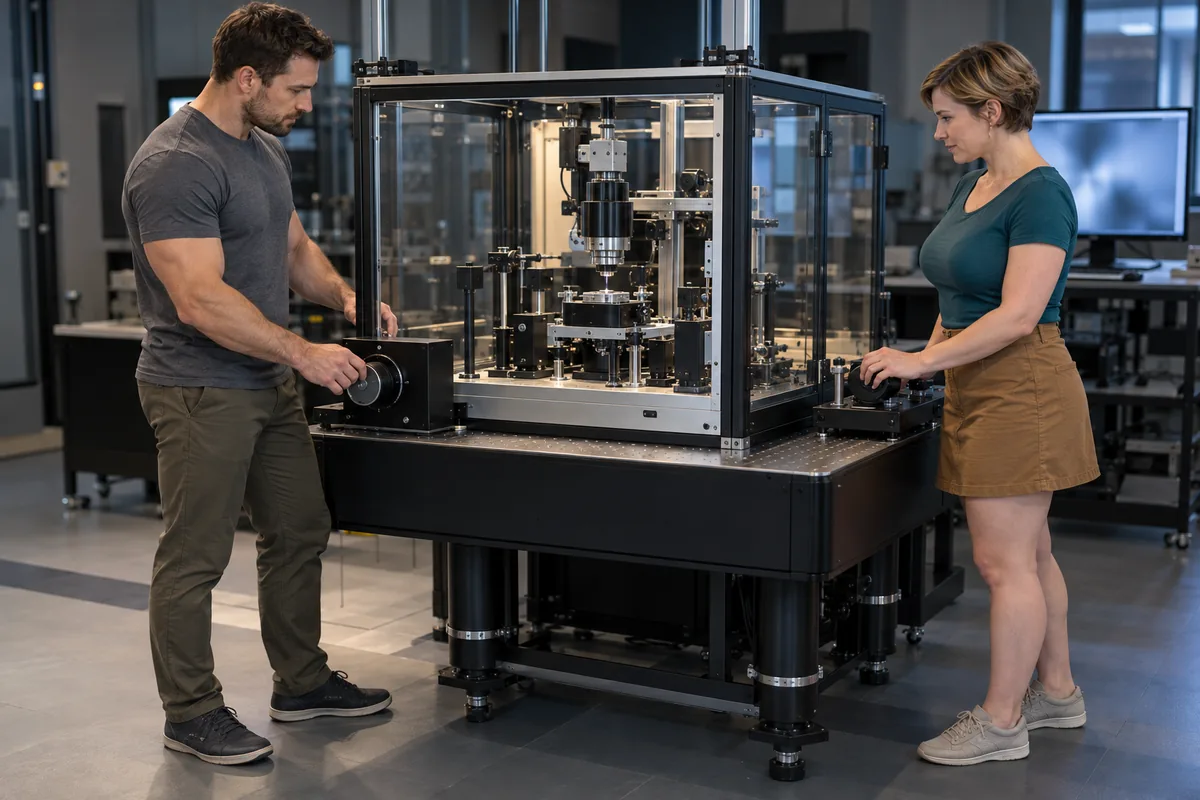


AI-generated concept imagery · imagined settings and equipment
Next review · October 2, 2026
One species, one destination surface and a serial/parallel comparison
Queued · Lead: Ben Đ Om
Acceptance: Compare verified delivery per second at the same survival and placement-error requirements.
Resources: Model-only phase. This is a planning allowance, not a funded commitment.
Download the experiment work pack · View the next work cycle
The vision
What this could become.
Treat an atomic pattern as a fabrication instruction. An array-directed optical system positions many traps, routes atoms through shared workspaces, and verifies each placement. The long-term goal is controlled assembly onto a fabricated device, with throughput improved through parallel work and carefully managed handoffs.
Begin today
The first concrete step.
Model the optical train and mirror steering, then compare serial transport, parallel lanes, and overlapping handoff sequences using the same loading and survival assumptions. Select a demonstrated trappable atomic species and a realistic destination interface.
The LSM connection
Lightloom could fabricate test structures for LSM experiments and investigate materials suggested by the model. Optical trapping itself has an established electromagnetic basis; LSM-specific fabrication targets need separately specified, measurable predictions.
Current evidence & open ground
Researchers have demonstrated large neutral-atom tweezer arrays and transport between traps. Trapping cold atoms in a vacuum is distinct from attaching arbitrary atoms to a solid device. Surface capture, bonding, contamination, temperature, and placement verification are separate unsolved steps for this proposal.
Manetsch et al., Nature (2025) — 6,100 atomic qubits ↗Demonstrated neutral-atom arrays and trap-transfer operations; not solid-device assembly.
Barredo et al., Nature (2018) — three-dimensional atomic structures ↗A baseline for atom-by-atom rearrangement in optical traps.
Questions that move the work forward
- Can the selected dual-axis mirrors provide sufficient steering, bandwidth, wavefront quality, and optical power per trap?
- Can overlapping traps hand off an atom with lower loss or shorter cycle time?
- What surface process captures the atom at the intended site and confirms it stays there?
Four ways to increase throughput
Parallel lanes move separated atoms simultaneously. Pipelining loads one region while another moves or verifies. Frequency or polarization separation can reduce unwanted interference, although the total trapping potential and collisions still matter. Controlled spatial overlap can enable handoff, but must be optimized for heating and loss. Overlapping beams do not automatically create independent traps or double speed.
Planning model
R ≈ Mη / tcycle
M is simultaneous moves; η is verified delivery yield. For sequential stages, cycle time is their sum. With independent pipelined stages, the slowest stage sets the ideal cycle time. Shared optics, power, transport conflicts, and verification reduce that ideal.
Test the gain: compare verified placements per second at the same error limit—not just mirror speed.
Proposed milestones / not completed results
A path to evidence.
Route light
An optical model comparing MEMS steering with SLM/AOD baselines.
Advance when: Report usable trap count, optical efficiency, pointing noise, and field of view.
Move in parallel
Matched serial, parallel-lane, interleaved, and overlap-handoff trials.
Advance when: Measure atoms delivered per second at fixed survival and placement fidelity.
Attach and verify
A separate trap-to-surface interface experiment on a defined test device.
Advance when: Verify site occupancy and retention; report device yield, not just trap occupancy.
Visitor feedback
Comments or suggestions?
Share your thoughts on Lightloom. Your message goes to the site owner’s private inbox.
No sign-in required. Your message and optional contact details are saved privately for review, not published. Add an email address if you would like a reply; a response is not guaranteed. Please avoid sensitive information.