Theoretical Research — Experimental Validation Required
VORTEX
Spin the lattice. Rewrite the trajectory.
Velocity-Optimized Rotational Tensor Excitation: test whether staggered superconducting rotor arrays can produce a controllable gravitational response through the hypothesized LSM substrate.
L / Advanced Propulsion · LSM · Experimental Gravitation
A different geometry.
A measurable question.
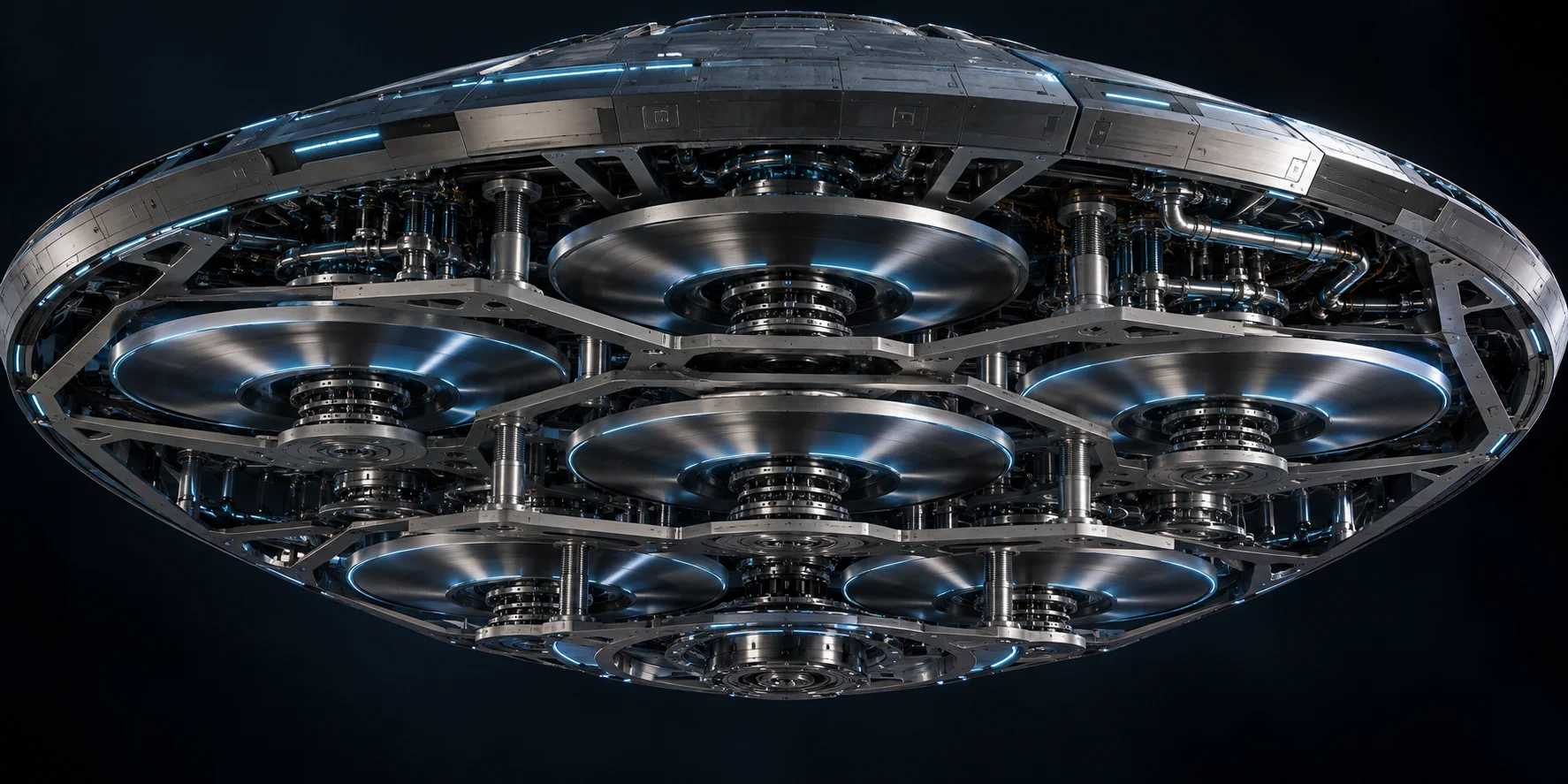
Offset the centers. Overlap the fast-moving rims. Investigate whether a more uniform projected source produces a detectable response.
Research premise: neither superconducting gravitational shielding nor the proposed LSM coupling is experimentally established.
Explore the rotor array ↓Read the experimental gates ↗01 / The distinguishing hypothesis
Cover the center with another rotor’s rim.
VORTEX proposes many independently driven superconducting disks with deliberately offset rotation axes. A rigid disk has local tangential speed v(r) = ωr: zero on its axis and largest at its outer edge. If an unknown lattice interaction follows speed, kinetic-energy density, or gradients of motion, the useful source might be concentrated toward the rim.
A coaxial stack repeats the low-speed central region. A staggered hexagonal, multilayer arrangement instead aims to overlap high-speed annuli across a chosen footprint. The visual analogy is interlocking Olympic rings arranged on a triangular lattice. The objective is a substantially uniform projected excitation region; whether it produces a gravitational response remains the question.
Wᵢ is 1 inside disk i’s projected footprint and 0 outside; sᵢ is an unknown hypothetical superconducting coupling factor. C is dimensionless. For unequal radii this is a normalized radial-speed proxy, not an absolute kinetic-energy density. A physical energy-density source would also require density, radius, thickness, and material-response terms.
For an infinite triangular array of full circular footprints, d ≤ √3R covers the plane. This says nothing about outer-annulus coverage or the edges of a finite array. It also implies overlapping disks if placed in one plane: equal disks in a common plane require d ≥ 2R before clearance. VORTEX must achieve projected overlap through axial separation. The simulator checks pairwise disk intersections and explores two-layer AB, three-layer ABC, and larger repeating arrays.
02 / VORTEX-0
Explore the coverage. Count the mechanics.
Mechanical & geometric model only. C is a dimensionless coverage proxy. Colors do not represent gravitational shielding, lift, or a measured field.
Both maps share one absolute color scale. White circle: common measurement footprint. Faint outlines: complete disk footprints. Maps zoom into that circle; outlines may extend beyond the view. The assembly view below shows the full array. Heatmap values are evaluated only inside the measurement circle.
Drag / arrows: rotate · Shift-drag: pan · wheel / pinch: zoom. Exploded z scale ×4; side elevation is to scale.
Model assumptions, comparison, and search bounds
All rotors are parallel uniform solid disks. Shafts, hubs, reinforcement and motor masses are excluded. Nominal density 6,000 kg/m³ is an editable ceramic-scale assumption, not a certified material specification. No strength, critical-field or superconducting-current rating is inferred.
A triangular center lattice uses pitch d. Layer offsets are k(d/2, √3d/6) times the offset multiplier, with k = 0,1,2 for ABC or 0,1 for AB. Finite arrays are centered on their mass centroid. Counts need not fill complete hexagonal shells; 7 disks per layer gives a center plus six neighbors.
The coaxial comparison places all N disks on distinct planes, with the same axial pitch. It preserves rotor mass, RPM, energy, and direction pattern, but usually has greater stack height than the offset array. This difference is reported; equal projected coverage is not assumed. Zero RPM gives zero C and zero active annular coverage.
The live metric grid is 81 × 81, clipped to the circular footprint. Minima and coverage percentages are sampled estimates, not continuous guarantees. Search evaluates 42 combinations of pitch (1.00–1.40 diameters) and offset (0–1.5) on a 37 × 37 grid, rejects rotor intersections, and ranks annular coverage first, minimum C second, and coefficient of variation third. The selected candidate is reevaluated on the finer live grid. It is a bounded numerical search, not a proof of optimality.
For geometry, all hypothetical weights sᵢ = 1 and reference speed ω₀ = 1,000 RPM. No superconducting gain or gravity coefficient is assumed. Direction changes signed angular momentum, but cannot change this even-in-speed C proxy. Vertical spacing affects collisions and height, not the projected map.
03 / Proposed LSM mechanism
Four couplings to distinguish.
The LSM proposes an HCP substrate with tetrahedral and octahedral interstices. VORTEX asks whether coherent superconducting rotation can drive a collective rotational or shear degree of freedom. The site’s current LSM foundation also distinguishes HCP from FCC local constructions; the geometry alone does not supply a gravitational coupling law.
| Hypothesis | Possible discriminator | What remains missing |
|---|---|---|
| Rotational entrainment | Response odd in signed spin or linked to total angular momentum. | A defined lattice rotational mode and symmetry-consistent coupling. |
| Velocity-squared coupling | Even under reversal; scales with ω² at fixed geometry. | A derived source normalization and energy transfer law. |
| Differential rotational shear | Change relative rotor directions or speed differences while monitoring total J. | A spatial interaction kernel; differences between disconnected rotors are not automatically material shear. |
| Superconducting coherence | Compare above/below the measured transition and a matched normal-state control. | Evidence of a response distinct from changes in magnetism, heating or mechanical behavior. |
These are phenomenological research parameterizations, not derived LSM equations. The coefficients a, b, c, screening length ℓ, response θ, source shape fᵢ, and conversion λ are unknown. The subscript i+1 must denote a declared spatial neighbor graph in an actual array, not an arbitrary listing order. Counter-rotation can increase this candidate relative-speed term while reducing net angular momentum and conventional gravitomagnetic contributions; those predictions must be tested separately.
For dimensionless θ, S must have units m⁻² and λ units m²/s²; the coefficients must carry the remaining units dictated by fᵢ and ω. The linear signed-spin term also needs a defined orientation/reference and consistent parity. A scalar screened-Poisson equation is only a static ansatz: boundary conditions, causal dynamics, stability, energy, momentum, equivalence-principle behavior and the connection to a metric remain unspecified. There is no calculated gravitational transfer function on this page.
Derive the three-dimensional Green function or numerical field response before interpreting a projected map as a screening plane. Even a uniform projected source can have a nonuniform field above it. Height dependence, sign changes and an alleged focus must be predictions of that response law, not effects painted into the illustration.
04 / Historical evidence
Reported anomalies. Replication limits. Established gravity.
Historical experiments motivate a controlled investigation, but do not demonstrate a gravity shield. Their apparatus and reported sensitivity differ; a null result constrains the conditions actually tested.
| Primary work | Finding and scope |
|---|---|
| Podkletnov & Nieminen, 1992 · Physica C 203, 441–444 | Reported apparent weight reductions above a levitating, rotating YBCO superconductor. This was a claim of an anomaly, not established gravitational shielding. |
| Podkletnov, 1997 preprint | Reported rotational weight changes of 0.3–0.5% and transient braking peaks of 1.9–2.1%. Described a toroidal disk and an annular vertical measurement region, not a demonstrated isolated focal point. |
| Li et al., 1997 · NASA static test | Measured changes smaller than 2 × 10⁻⁸ of normal gravitational acceleration with DC-levitated YBCO. This static test did not reproduce a complete rotating, RF-driven arrangement. |
| Woods et al., 2001 · AIAA 2001-3363 | Reported no measurable gravity modification within ±0.03% for a subset of the proposed conditions. The authors did not claim every original condition was reproduced. |
| Hathaway, Cleveland & Bao, 2003 | Rotating-superconductor/RF replication attempt reported no weight modification or gravity-like force at the 0.001% level. Support and drive differed from the original claimed apparatus. |
| Tajmar et al., 2006/2007 | Reported sensor signals near rotating superconductors and investigated a possible gravitomagnetic interpretation. The interpretation was provisional. |
| Tajmar, 2011 | Improved measurements found no anomaly within ±5 × 10⁻⁸ rad/s (three times setup noise), rejecting the earlier large coupling. Noise and analysis artifacts were implicated; acoustic disturbance was considered for older measurements. |
| Tajmar, Neunzig & Kößling, 2022 | A separate superconducting-current experiment found no force at about 100 nN resolution for currents up to 15 A. Its review describes the retreat from earlier gravity-like interpretations. This is not a test of offset rotor arrays. |
| Everitt et al., 2011 · Gravity Probe B | Measured frame-dragging drift −37.2 ± 7.2 milliarcseconds/year versus the GR prediction −39.2. Earth’s conventional frame dragging is established evidence for gravitomagnetism, not shielding or a superconducting enhancement. |
The new VORTEX conjecture: if an undiscovered coupling is localized near high-speed regions, central-only measurements may undersample a spatially structured response. Offset arrays offer a distinct geometry to test. Earlier null results are not thereby explained away; no hidden gravitational focus is established. A full three-dimensional scan, with equal-energy coaxial and staggered controls, is the discriminating next step.
05 / Modular testbed
Separate the source from the measurement.
Controlled source
- Independently controlled high-speed rotors with tachometry, signed speed and phase records.
- Separate axial planes, adjustable triangular pitch and lateral offsets, accessible bearings and supports.
- Characterized superconducting specimens with measured transition, critical field/current behavior and temperature gradients.
- Cryogenic management, appropriate vacuum operation, balanced shafts, rotor-fracture containment and remote shutdown.
Independent instrumentation
- Optical displacement measurement and calibrated differential gravimetry.
- Multiple reference test masses with varied magnetic susceptibility, conductivity, density and composition.
- Reference sensors outside the projected rotor region, synchronized acquisition and documented timing.
- Vibration, acoustic pressure, temperature, pressure, magnetic-field, leakage-current and drive-power monitoring.
The apparatus must distinguish local force on a suspended test mass from an actual change in gravitational acceleration. Use isolated source and sensor supports, electrical and magnetic shielding, thermal equilibration, buoyancy accounting, and mechanically matched dummy drives. Moving rotor mass also produces ordinary Newtonian gravitational changes; calculate those before attributing a residual.
The simulator assumes solid disks. Annular hardware requires I = ½m(Router² + Rinner²), revised mass and a removed central footprint. The displayed ρv² is only a centrifugal stress scale, not a solved peak stress or permissible rating. Ceramic defects, hub stress concentrations, reinforcement, critical speeds, cryogenic contraction, fatigue, quench transients and fragment containment determine an operating envelope. RPM limits in the UI are exploration bounds, not approved operating speeds.
Count spin-up energy, bearing/drive losses, cryocooler electrical input, magnetic shielding loads and heat rejection. Stored rotational energy is not continuous output power. Adjacent surfaces in vacuum do not acquire mechanical shear coupling merely because their angular velocities differ.
06 / Evidence-gated development
Earn each stage with a result.
Freeze the geometry, null hypothesis, primary observable, sensitivity target, analysis window and exclusion rules before acquisition. Randomize blinded operating states; retain raw data and instrument calibration. No experimental anomaly has been measured by this project.
| Phase | Observable & controls | Advance criterion / falsification |
|---|---|---|
| VORTEX-0 · geometry | Compare sampled C, annular coverage and σ/C̄ over a fixed footprint. Hold N, R, RPM and density fixed; report different stack heights. Check collisions and refine the grid. | Advance on reproducible nonintersecting geometry with a declared coverage improvement. Reject a candidate if the improvement disappears on mesh refinement, requires intersections, or depends only on changing the target area. |
| VORTEX-1 · single disk | Measure differential Δg or calibrated test-mass force as a function of radius, height, RPM, spin direction and temperature. Include stationary, normal-state, dummy-rotor and drive-only controls. | Advance only on an effect exceeding a preregistered combined uncertainty and surviving blinded repetitions and environmental regressions. A null yields a sensitivity-bounded limit for this apparatus; artifacts reject the anomaly interpretation. |
| VORTEX-2 · two / three layers | Map both sides and several heights; compare AB, ABC, aligned and coaxial cases, co- and counter-rotation at matched speed/energy. Reverse source orientation where practical. | Require a preregistered spatial signature and geometry-dependent response predicted by one shared model. Reject that model if direction, temperature or height behavior contradicts it, or the response tracks vibration/EM changes instead. |
| VORTEX-3 · modular hexagonal testbed | Repeat multiple modules with independent instruments and an external laboratory; compare test-mass compositions and switching sequences. | Advance on independent replication, stable calibration and a constrained coupling model with explicit residuals. Reject scaling if signal follows apparatus-specific backgrounds or fails replication at the declared sensitivity. |
| VORTEX-4 · full-area generator, conditional | Map field uniformity, source/support reactions, efficiency, thermal load and long-duration stability across the entire protected area. | Require independently reproduced response plus closed energy and momentum budgets. Reject a useful-area claim if coverage, stability or power requirements fail declared engineering targets. |
| VORTEX-5 · propulsion demonstrator, conditional | Measure whole-system thrust, onboard energy, expelled mass, external field/body reactions and control authority. Use orientation reversals and independent force measurements. | Require net acceleration distinguishable from support forces, gas flow, electromagnetic interactions and instrument bias. A gravity-cancellation result alone does not meet this propulsion gate. |
Measurements that distinguish the competing models
Map center, rim, inter-rotor gaps, outside-array reference points and several positive/negative heights. Record steady-speed states separately from acceleration and braking. Compare speed scaling and reversal parity; vary absolute spin and differential spin independently. Cross the measured superconducting transition while matching and monitoring thermal and magnetic conditions. A temperature-correlated signal by itself is not evidence of gravity.
A null result does not falsify every imaginable coupling. It excludes a specified model, parameter interval and spatial response above the stated instrument sensitivity. The theory must provide a nonzero quantitative prediction before a decisive physical falsification is possible. Publish bounds and failed tests alongside positive candidates.
07 / Conditional application
A personal spacecraft is the destination.
The long-term objective is a practical, reusable personal spacecraft for terrestrial departure and spaceflight. The proposed embodiment puts a multilayer rotor array beneath a broad disk-shaped hull, with cryogenics, power electronics and containment integrated above it.
| Envisioned function | Required result |
|---|---|
| Reduce, cancel or reverse local gravity | A reproducible gravitational coupling with a calibrated sign and amplitude. |
| Differential lift, pitch and roll | A spatial response model with measured control authority and source reactions. |
| Directional modulation and maneuvering | A verified mechanism transferring momentum to an external body or field. |
| Inertial-load modification | A separate unproven hypothesis; gravitational response would not establish it. |
Shielding and propulsion are different claims. Canceling Earth’s attraction would remove a downward acceleration; it would not automatically produce upward thrust, orbital speed, or acceleration in deep space. Reversing the force would be an additional result to demonstrate. Propellant-free operation must still conserve energy and momentum, including exchange with fields, external bodies and the hypothesized substrate. Counter-rotating internal rotors alone do not accelerate a closed system’s center of mass.
This is the engineering motivation for the research, conditional on every preceding validation gate—not a forecast of an available spacecraft.
08 / Open theoretical work
The questions that determine feasibility.
- Does LSM permit any superconducting-rotation/gravity interaction?
- Is its response odd in spin, quadratic in speed, dependent on differential rotation, or absent?
- Can its coefficients and length scale be derived from a shared LSM dynamical law?
- What three-dimensional response follows from a finite annular source?
- Does offset geometry improve that field rather than only projected coverage?
- Does superconductivity change the response beyond known electromagnetic effects?
- What falsifiable behavior is expected across the measured transition temperature?
- Can the model recover general relativity and satisfy equivalence-principle constraints?
- What operating limits follow from stress, cryogenics, quench behavior and heat rejection?
- Can a detected interaction scale with complete energy and momentum accounting?
| Epistemic status | Examples on this page |
|---|---|
| Established mechanics | v = ωr; solid-disk inertia; rotational energy; conservation laws. |
| Exact or numerical geometry | Triangular-lattice covering bound; finite sampled annular coverage and collisions. |
| LSM-specific assumptions | Hypothesized HCP substrate and unspecified superconducting lattice coupling. |
| Speculative consequences | Gravity cancellation, reversal, inertial modification and personal spaceflight. |
| Experimentally testable | Predeclared spatial, speed, direction and temperature signatures with stated sensitivity. |
09 / Results ledger
Ready for evidence.
October 15, 2026: VORTEX-0 geometry/mechanics model and research program published. The simulator’s outputs are numerical model results. No rotor prototype, gravitational anomaly, lift or propulsion result is reported.
| Future record | Required contents |
|---|---|
| Geometry release | Model version, inputs, export, resolution convergence and collision report. |
| Bench run | Calibration, specimen, actual temperature/RPM, blind state codes, raw time series and controls. |
| Analysis | Preregistered model, uncertainty budget, exclusions, residuals and null bounds. |
| Replication | Independent apparatus, complete method, positive or null outcome and reusable data. |
10 / Connected research
One geometry experiment in a wider program.
- Lattice Structure Model — the proposed geometric foundation and unresolved dynamics.
- Lattice Drive — momentum exchange, inertial response and occupant acceleration as distinct claims.
- Katzenblitz / Gyroencabulator — high-speed rotor, containment and thermal engineering questions.
- Matter-Assembling AFM System · staff access — related substrate-control research; its detailed content remains protected.
- Meridian — terrestrial departure and separate orbital-energy requirements.
- Dewcell and Earth Radiator — conditional power supply and complete heat accounting.
References in the historical table are primary publications or author manuscripts. Their findings do not validate VORTEX. Technical model revision: VORTEX-0 v1, 2026-10-15.
Visitor feedback
Comments or suggestions?
Share your thoughts on VORTEX. Your message goes to the site owner’s private inbox.
No sign-in required. Your message and optional contact details are saved privately for review, not published. Add an email address if you would like a reply; a response is not guaranteed. Please avoid sensitive information.